 Art
 Jewelry
 Toys and entertainment
 Home & Decor
 Collectibles & Vintage or Antique
 Eco-friendly products
 Clothing & Bags
Also available in: العربية · Français
By Ouafra · Crafts & Terroir Blog
As of mid-June 2026, Morocco officially counts 69,193 cooperatives registered with the ODCO (Office for the Development of Cooperation), bringing together 825,754 members, including 280,772 women (34% of members) and 18,512 young graduates. In under six months the sector added nearly 4,000 new structures and more than 36,000 members compared with the end of November 2025.¹
These figures are not trivial. They signal a quiet but real transformation of Morocco’s economic fabric, and for artisans, argan cooperatives, High Atlas weavers and aromatic-plant producers, they open a pivotal period.
A growing sector whose potential remains under-used
The cooperative sector now represents nearly 3% of national GDP and 5% of the working population.² Solid figures, but they mostly reveal a gap between what the model could produce and what it actually produces.
That is precisely the diagnosis made by Lahcen Essaadi, Secretary of State for Crafts and the Social and Solidarity Economy, at the ODCO Board in July 2026: “The cooperative sector holds far greater potential than its actual contribution. That gap underpins the national ambition: raising the sector to 8% of GDP and generating 50,000 jobs a year by 2035.”²
To get there, the ODCO is moving away from fragmented actions toward a deep transformation of its support model, built around five concrete tools.
The 2026–2028 roadmap: five tools to change scale
The three-year roadmap validated in July 2026 rests on an integrated digital ecosystem designed to modernise every stage of a cooperative’s life:¹²³
1. The Integrated Information System (SII): a national database to steer public policy with reliable data by region and sector. For artisans, it means better visibility of their sector to institutions, funders and public buyers.
2. The Cooperative Project Bank: a catalogue of viable initiatives adapted to each territory. An embroidery cooperative in Fès-Meknès has neither the same needs nor the same outlets as an argan oil cooperative in the Souss.
3. Sijil Coop: dematerialisation of creation and management procedures. Since June 2026, online declaration is generalised. Creating a cooperative, filing accounts or reporting a change of status can all be done online, with no trip to Rabat.
4. The Cooperative Marketplace: a national platform to sell cooperatives’ products directly to public and private buyers. The signal is strong: the State acknowledges that the problem for cooperatives is often not production but access to market.
5. Taawounya Academy: a distance-learning platform for cooperative members. Accounting, management, marketing, quality: the skills missing in most small craft structures.
What this concretely changes for artisans
1. Joining a cooperative becomes simpler, and more strategic
With Sijil Coop and full dematerialisation, the administrative barrier to creating a cooperative disappears. A zellige craftsman in Fez, a saffron producer in Taliouine or a group of embroiderers in Tetouan can now structure their activity without an intermediary.
But the stakes go beyond paperwork. Joining a recognised cooperative means accessing several schemes at once: INDH funding, ODCO training, AFD or USAID programmes and, increasingly, regional institutional programmes.⁴
2. New opportunities in the regions
In June 2026, the Mohammed V Foundation for Solidarity launched a call for projects to support cooperatives, unions and craft GIEs in the Tangier-Tetouan-Al Hoceima region, within an unprecedented partnership between five institutions: the Foundation, the TTA Regional Council, the Ministry of Tourism and Crafts, the ODCO and the Maison de l’Artisan.⁵
The aim is to accelerate the region’s socio-economic development by promoting the North’s specific crafts: embroidery, pottery, Andalusian textiles. It is the first step of a multi-regional programme.
In Tangier, as early as October 2025, the Tanger Med Foundation, the APDN and the ODCO launched a similar programme: 30 cooperatives supported in governance and marketing, with a two-month exhibition at Tanger-Ville station to showcase their products to travellers.⁶
3. Women’s cooperatives: from informal to export
SIAM 2026 (International Agriculture Show, Meknes) highlighted what is happening in the territories: 100% women-run cooperatives that now master the whole value chain, from terroir to export-ready finished product.
The Bouhassoune cooperative (Bouizakarne, Guelmim), founded by university graduates, illustrates this movement: argan → amlou → honey → cosmetics → soap. Its president, Khadija Bouhassoune, obtained a food-safety certificate allowing export after several national and international fairs.⁷
In the Southern provinces, Sahrawi cooperatives have moved in a few years from informal craft to structures able to export and hire sustainably, relying on public schemes and well-identified terroir sectors: daghmous honey, argan, amlou, couscous, aromatic plants.⁸
4. Scoring: a new form of credibility
One of the most structuring measures of the 2026–2028 roadmap remains discreet but potentially decisive: a performance-based scoring system for cooperatives.¹
Concretely, each cooperative will be assessed on governance, financial transparency and impact. The best rated will get priority access to public procurement, grants and institutional partnerships.
For serious cooperatives that work well but remain invisible, this is an opportunity. For those that existed on paper without real activity, it is a welcome push toward professionalisation.
What this means for Ouafra, and for you
Ouafra operates precisely in the space these reforms seek to activate: connecting very real craft cooperatives to buyers, institutions and markets that do not yet know them.
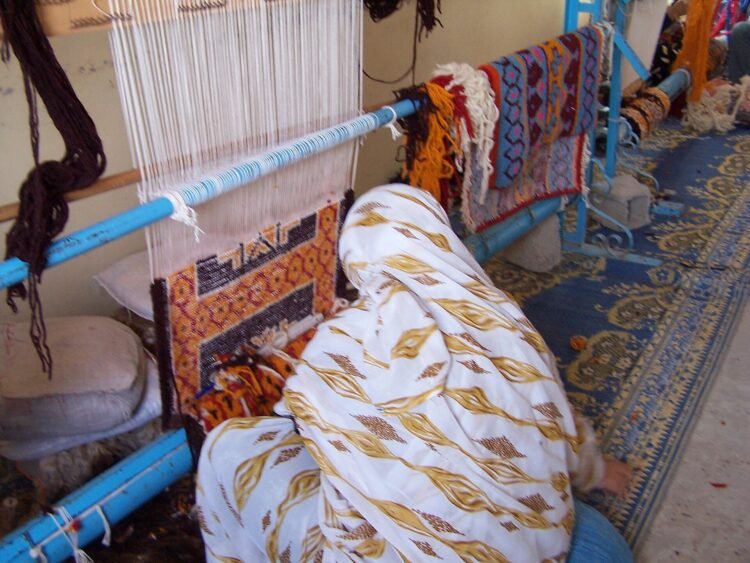
Morocco’s 69,193 cooperatives are not an abstract number. They are maalems in Fez, weavers in the Atlas, prickly-pear oil producers in the Souss, embroiderers in Tetouan, potters in Safi. A considerable human fabric, of which only a tiny fraction is visible outside its territory today.
The Ouafra catalogue, and the support programme around it, is designed to close exactly that gap: from cooperative to market, in 5 days.
Going further
If you represent an institution, a development programme or a B2B buyer who wants to work directly with Moroccan craft cooperatives, contact the Ouafra team.
If you are a craft cooperative and want to join the catalogue, start here.
Ouafra is a platform that promotes and sells the products of Moroccan craft cooperatives and terroir producers. Based in Fez, it connects cooperatives to national and international markets through a curated catalogue, field support and a digital presence.
References
¹ ODCO — Conseil d’Administration, juillet 2026 : De la logique d’appui à la logique de création de valeur
² Aujourd’hui le Maroc, 6 juillet 2026 : Plus de 69 000 coopératives recensées à fin juin 2026
³ Le Matin, juillet 2026 : L’ODCO change de modèle pour faire des coopératives marocaines un moteur de croissance
⁴ JobSquare.ma, juin 2026 : Artisanat et économie créative au Maroc en 2026
⁵ Aujourd’hui le Maroc, 26 juin 2026 : Artisanat : un appel à projets pour l’appui et l’accompagnement des coopératives au Nord
⁶ ODCO, octobre 2025 : Lancement à Tanger du Programme de Soutien à l’ESS 2025-2026
⁷ LeBrief.ma, avril 2026 : SIAM 2026 : ces coopératives 100% féminines qui valorisent le terroir marocain
⁸ LeBrief.ma, avril 2026 : Du terroir à l’export, la montée en gamme des coopératives sahraouies
Photo: Parc National de Souss-Massa / Wikimedia Commons, CC BY-SA 3.0
 Français
 Arabe
 English