 Art
 Jewelry
 Toys and entertainment
 Home & Decor
 Collectibles & Vintage or Antique
 Eco-friendly products
 Clothing & Bags
Also available in: Français · العربية
By Ouafra · Crafts & Terroir Blog
A global market worth $1.75 billion in 2025, projected to exceed $6 billion by 2035.¹ Annual growth of 12 to 15%, driven by the worldwide appetite for clean beauty and natural ingredients. A forest classified as a UNESCO biosphere reserve since 1998. A know-how inscribed on humanity’s intangible heritage.
And yet in Ameskroud, Fatima El Mehni, president of a cooperative, now produces 50 litres of oil a month, against 3,000 litres a few years ago. In Agadir, Fatima Amehri (Ida Imtat cooperative) sums it up: “We have made only minimal profits over the years, which limits our growth.”
And across the Souss-Massa region, a question nobody asks loudly enough: if argan earns so much, why are the people who produce it getting poorer?
A product born here, captured elsewhere
Argan oil was not always a global star. Until the 1990s it was used locally, by the Amazigh communities of the Souss, for cooking and traditional care. What changed everything was the meeting of science (anti-ageing properties documented from the 1990s), international cosmetic demand and European development programmes.
The European Union and GIZ (German cooperation) worked with the Moroccan government to formalise production into export-oriented cooperatives. The model looked perfect: organised producers, independent income, traceable production. What development agencies called a “triple win”: economic inclusion, rural development, environmental sustainability.³
The problem arrived with success.
70% of the market captured by a single French company
Moroccan production now reaches 4,000 to 6,000 tonnes of oil a year, with exports of 1,000 to 1,500 tonnes annually.⁴ Morocco accounts for 22% of the world argan market.⁵
But who actually exports? Olvéa, a French multinational from Normandy, established in Morocco since 2005, now controls 70% of argan oil exports.⁶ What was twenty years ago almost the exclusive domain of local cooperatives, which made up more than 80% of exports, is now concentrated in the hands of a foreign industrial player.
The mechanism is documented and brutal: large companies buy nearly all the fruit available on regional markets, especially in drought periods when the resource becomes scarce. The price of the nut rose from 0.20 to 1.20 dirhams per kilo, making supply impossible for cooperatives that cannot absorb these costs.²
“Olvéa has an oligopoly and can afford to buy all the available fruit,” explains Fatima Amehri, president of the Ida Imtat cooperative near Agadir.⁷
The value chain dissected: who wins at each level
The argan paradox is a textbook case of value capture in global chains. A study published in the World Development Perspective Journal states it unambiguously: all of the sector’s profits are made at the top of the chain, leaving producers with “unequal and derisory” pay for skilled work.⁸
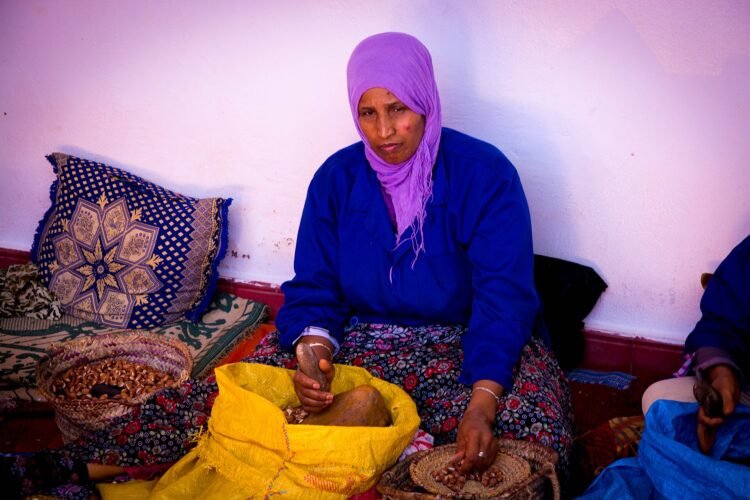
At the bottom: the producers: women, young people, rural families. They gather the fruit, crack the nuts by hand (a precise and gruelling gesture) and extract the raw oil. Skilled, seasonal, physically intense work. Pay: a few dirhams per kilo.
In the middle: industrial processors: Olvéa, ZineGlob, ARGANisme. They buy raw oil, refine, certify and package it. This is where most of the commercial value is created.
At the top: global cosmetic brands. They formulate, market and sell with stories of “ancestral traditions” and “Berber women”. Their margins: several hundred percent.
Morocco’s name, a foreign brand
The most striking illustration of this appropriation remains MoroccanOil, an Israeli-American brand based in Tel Aviv, popular in North America and Europe. It sells argan-based hair products using Morocco’s geographic and cultural identity as a marketing argument, without Morocco, its producers or its cooperatives receiving anything from its revenue.
And MoroccanOil is not an isolated case. Pierre Fabre, a French pharmaceutical group, registered the name “Argane” as a trademark in 1983. Although a French court recognised in 2013 that “argan” designates a generic tree endemic to Morocco, the country still has no internationally recognised Protected Geographical Indication (PGI) for its argan oil.⁶
Its own natural heritage remains legally vulnerable.
Not only a gender issue: the problem of transmission
The argan crisis is often presented as a crisis of “rural women”. That is a reduction that hides a deeper fracture: that of transmission and of the future.
At the Marjana cooperative (Essaouira), the average age of workers is over 60. Samira Chari, 42, is the youngest. Founder Amel El Hantatti admits: “Young people no longer take up this trade,” despite persistent local unemployment.² The physical work of cracking nuts is off-putting. Income is uncertain. And prospects seem blocked in the face of industrial competition that sets the prices.
It is not only a question of working conditions. It is a question of economic meaning. Why join a sector whose value is systematically captured by others?
What the young people who stay are doing, and innovating
Yet another reality exists, less publicised. In 2025, the ODCO’s “Generation of Solidarity” National Prize, themed “Youth cooperatives: building a more sustainable and inclusive world”, awarded 28 youth-led cooperatives, selected from 318 applications. Sectors represented include crafts, sea fishing, education and training, and argan production.⁹
These are young graduates returning to terroir sectors not to reproduce the raw-extraction model but to move up the value chain: local processing, organic certification, direct sales, e-commerce, packaging design, brand storytelling.
The Bouhassoune cooperative (Bouizakarne, Guelmim), founded by university graduates, illustrates it at SIAM 2026: argan → amlou → honey → cosmetics → soap. An integrated range, an export health certificate obtained, a presence at several international fairs. President Khadija Bouhassoune speaks directly to other young people: “Don’t stay without launching a project idea. The INDH makes it possible to realise projects.”¹⁰
The momentum exists. It needs to be amplified, not confined to national prizes.
The paths that exist, and their limits
Vertical integration
A few cooperatives have managed to move up the chain by developing their own finished products. Terra Natura Morocco, Coopérative Yacout and Coopérative Mabio Cosmétique, listed on terroirdumaroc.gov.ma, offer complete ranges from raw oil to packaged care products. This is the model Ouafra seeks to multiply: promoting cooperatives that process locally.
Diversification
Some producers are pivoting in the face of the argan sector’s insecurity. Farida (not her real name), in her fifties, launched a pilot project of aromatic herbs between her 30 argan trees and opened a restaurant for tourists.² A courageous adaptation, but one that does not solve the systemic question.
An international PGI
Pressure is growing for an international Protected Geographical Indication to be recognised for Moroccan argan. The process is long and runs up against the entrenched interests of industrial players who profit from the lack of protection. The Agadir International Argan Tree Show (4th edition, December 2025–January 2026) put the subject back on the agenda, within the “Generation Green 2020–2030” and “Forests of Morocco 2030” strategies.¹¹
The marketplace and training
The ODCO is rolling out a Cooperative Marketplace in its 2026–2028 roadmap. The terroirdumaroc.gov.ma platform lists producers directly. The Taawounya Academy will train cooperative members in management, marketing and quality. These tools are necessary, but insufficient without fair-pricing policies and direct access to international buyers.
What a responsible buyer can do, now
If you source argan oil, for your brand, hotel, B2B gifts or personal use, here are the concrete questions to ask:
1. Who produces it? If the supplier does not name the cooperative or group behind production, traceability is nil.
2. What share goes back to producers? A serious cooperative can state its purchase price from producers and compare it with the final sale price.
3. Is the oil processed in Morocco? Oil refined, packaged and certified in Morocco means local added value. Raw oil exported in bulk and processed in Europe does not.
4. Is the cooperative listed? Terroirdumaroc.gov.ma and the Ouafra catalogue are reliable starting points.
Ouafra’s position
At Ouafra we deliberately work with cooperatives that process locally, whether run by long-standing rural women or by young graduates reinvesting in their territories with new tools.
This is not an ideological position. It is an economic conviction: value must stay where it is created: in the hands of those who crack the nuts, in the workshops that package the oil, in the territories where the argan tree has grown for centuries.
If you are a B2B buyer who wants to source directly from certified, traceable cooperatives: contact our team. If you are a cooperative wanting access to our markets: join the catalogue.
Ouafra promotes and connects Moroccan craft cooperatives and terroir producers to national and international markets. Based in Fez.
References
¹ Global Growth Insights, janvier 2026 : Argan Oil Market Size, Share and Future Insights 2035
² Equal Times / Middle East Monitor, septembre 2024 : Morocco: Women-led argan oil co-ops struggle amid corporate takeover
³ LSE Middle East Centre, Kate Meagher, mai 2020 : The Scandal of Seamless Linkages: Global Value Chains and Women Argan Oil Producers in Morocco
⁴ Tridge, juillet 2026 : Argan Oil Suppliers, Export Data & Price Trends
⁵ Grand View Research, mars 2026 : Morocco Argan Oil Market Size & Outlook, 2026–2033
⁶ Morocco World News, juillet 2025 : The Great Argan Appropriation
⁷ Equal Times : Faced with competition from big business, Morocco’s argan oil cooperatives are being forced to close
⁸ World Development Perspective Journal, 2020, cité par The Ecologist, novembre 2025
⁹ ODCO, octobre 2025 : Generation of Solidarity 2025: 28 Youth-led Cooperatives Awarded
¹⁰ LeBrief.ma, avril 2026 : SIAM 2026 : ces coopératives 100% féminines qui valorisent le terroir marocain
¹¹ AllAfrica / MAP, décembre 2025 : Agadir célèbre l’arganier, un arbre emblématique du pays
Photo: Catalin Dordea / Wikimedia Commons, CC BY-SA 4.0
 Français
 Arabe
 English