 Art
 Bijoux
 Jouets et divertissements
 Maison & Déco
 Objets de collection & Vintage ou Antique
 Produits écologiques
 Vêtements et sacs
Also available in: العربية · Français
By Ouafra · Crafts & Terroir Blog
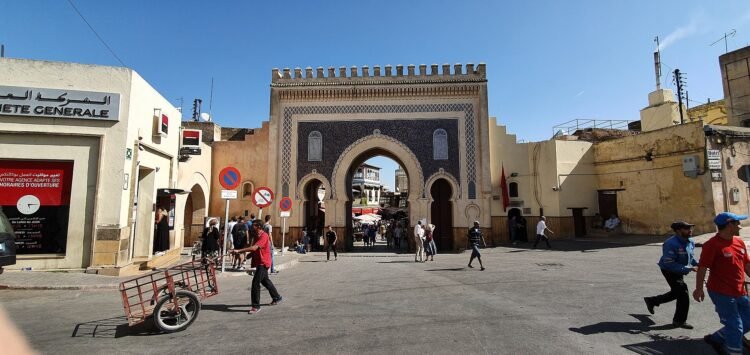
At 9 Derb Megana, a few steps from Bab Boujloud, the famous Blue Gate of Fez, stands an 18th-century foundouk that looks like all the others from the outside. A carved wooden door, a cobbled lane, the sound of the medina in the background.
Inside, something different is happening.
Artisans are weaving. International designers observe, ask questions, experiment. Visitors from around the world learn the gesture of hand-knotted weaving. And somewhere in the system, a rug maker in Azilal or an embroiderer in Midelt receives the proceeds of a sale directly, with no middleman, in real time, from her phone.
This is The Anou Cooperative, and its model is one of the most accomplished in Morocco’s craft sector today.
“Anou”: a well that irrigates
The name comes from Tachelhit, the Amazigh language spoken in the Souss valleys and the High Atlas. Anou means “water well”, the point around which a community gathers, shares and survives.
That is exactly the ambition of Dan Driscoll, its American founder, and the artisans who co-built the cooperative: “Rather than asking how we can help, we ask how to build a community of artisans that no longer needs foreign aid.”¹
Anou is today an award-winning national cooperative, owned and run by the artisans themselves, mostly women and young people from rural areas, many of whom had no access to formal education. It brings together more than 600 artisans across cooperatives, associations and workshops throughout Morocco.²
The problem Anou solves
To understand Anou, you first have to understand what it replaces.
In the traditional Moroccan craft market (Marrakech souks, medina shops, resellers’ Instagram pages) the artisan receives less than 4% of the final price paid by the customer.² Sometimes that does not even cover the cost of raw materials.
Classic fair trade pays a little better. But as Anou puts it: “Fair trade has existed for decades, yet Moroccan artisans are fewer and poorer than before.”² Paying a bit more is not enough to change the structure.
What is needed is wealth, real skills and, above all, real power. Anou therefore built an infrastructure so that artisans own all three.
The architecture of a direct model
The e-commerce platform (theanou.com) lets each artisan create a product listing, set a price, talk to buyers and track orders from a smartphone. The interface was designed without text, using icons, to be accessible to artisans with little schooling.
Artisan leaders: a network of managers selected from among the artisans themselves. They train others, handle local logistics and oversee quality, skills “usually reserved for middlemen and foreigners”, according to Anou.¹
A transparent supply chain: Atlas Wool Supply Co supplies spun and dyed wool. Natural dyes are traced. The carbon cost of travel to Fez can be offset through credits generated by the mill itself.
Self-financing: Anou is funded solely by a percentage of sales. No public subsidies, no foundations. “Just Moroccan artisans investing in their own company.”³
The Fez foundouk: where everything converges
The physical hub of the network is the Fez foundouk: shop, workshop, training space and residency hub in one. Lonely Planet, the Rough Guide and Le Guide du Routard all mention it. The New York Times recommended it as one of the best winter experiences in Fez.³
What happens here is richer than a simple shop:
Workshops: hand-knotted weaving, natural dyeing, textile techniques. Open to visitors and run directly by the cooperative’s artisans, a way of redirecting the tourism economy toward the real producers rather than intermediaries.
Artisan experiences: lunches, workshop visits, meetings with makers, bookable directly on theanou.com/experiences with no tour-operator commission.
Residencies: the most advanced programme, and today the most in demand.
Residencies: a new model of creative collaboration
In March 2026, Anou published a story that illustrates its way of working perfectly.
Julien, a designer, arrives in Fez not with sketches under his arm but with an intention: to explore. He spends time in the foundouk, meets the artisans and takes part in workshops. These first visits lead to a one-week residency.
During that week he works alongside Fatima Brahimi, artisan leader and president of the Afous GAfous Cooperative. Together they explore colour palettes, techniques and technical feasibility. The wool is spun and dyed at Atlas Wool Supply Co.
The result: a circular rug 5 metres in diameter, a piece that could not have existed without this immersion, this shared time, this trust built in person.⁴
This is not fair trade. It is co-creation.
The residency calendar is full until the end of October 2026. Applications for 2027 are now open on theanou.com.⁴
Extending the network: workshops from the territories
What began centred on the Fez foundouk now extends to artisans across Morocco.
Kabira, president of the Tizi Nougdal Cooperative, now runs her own workshops in Setti Fadma, in the Ourika valley (High Atlas), bookable directly on theanou.com/experiences without going through Fez. The income stays in her community.⁵
This is the Anou logic applied to the territories: each cooperative becomes an autonomous node of the network, able to generate its own tourism and craft income.
What the Anou model teaches the sector
Anou is often cited in reports on fair trade and the social economy. But beyond labels, what stands out is its systemic coherence:
— The technology platform solves the problem of market access.
— Artisan leaders solve the skills problem.
— Residencies solve the problem of how craft work is valued.
— Self-financing solves the problem of dependence on donors.
— The foundouk solves the problem of physical visibility.
Each building block reinforces the others. It is an ecosystem, not a programme.
Anou and Ouafra: two complementary models
At Ouafra we work in a different field (terroir products, natural cosmetics, Moroccan crafts in the broad sense), but we share with Anou a fundamental conviction: value must stay where it is created.
The Ouafra catalogue and the support programme we are building draw on this logic: fast onboarding, traceability, direct access to buyers, no unnecessary intermediary.
If you visit Fez, and we strongly recommend it, stop by 9 Derb Megana. Buy directly. Take a workshop. And if you are a designer, brand or B2B buyer, explore the residencies.
Practical information
Anou shop, Fez
9 Derb Megana, Fez medina (right of Café Clock, steps from Bab Boujloud)
theanou.com
Workshops & experiences: theanou.com/experiences
2027 residencies: applications open on theanou.com
Online shop: theanou.com (international delivery, made-to-order)
Ouafra promotes and connects Moroccan craft cooperatives and terroir producers to national and international markets. Based in Fez.
References
¹ CICOPA / The Anou Cooperative Medium, 2021 : Welcome to Anou
² The Anou Cooperative : About — theanou.com
³ The Anou Cooperative Blog, mars 2026 : Workshops and Residencies: Expanding the Artisan Economy
⁴ The Anou Cooperative Blog, mars 2026 : A Rug, A Residency, A New Model for Collaboration
⁵ The Anou Cooperative Blog, octobre 2025 : Workshops and Residencies: Expanding the Artisan Economy
Photo: Yair Haklai / Wikimedia Commons, CC BY-SA 4.0
 Français
 Arabe
 English